Tell us about the job
Takes about a minute. No obligation.
Sizing a central AC system for a Kent County home is not a catalog exercise. 90 severe weather events were recorded in Kent County, Michigan between 2015 and 2024. At that rate, severe weather is a steady background pressure on equipment here, real enough that a contractor has to factor it into load calculations, but not so dominant that it overrides the specifics of the house itself. Duct layout, ceiling height, window orientation, and insulation quality each pull the required capacity in ways that matter more than any single weather season. A contractor who skips a proper Manual J and estimates from square footage alone will produce a system that short-cycles or runs constantly, regardless of how the weather performs.
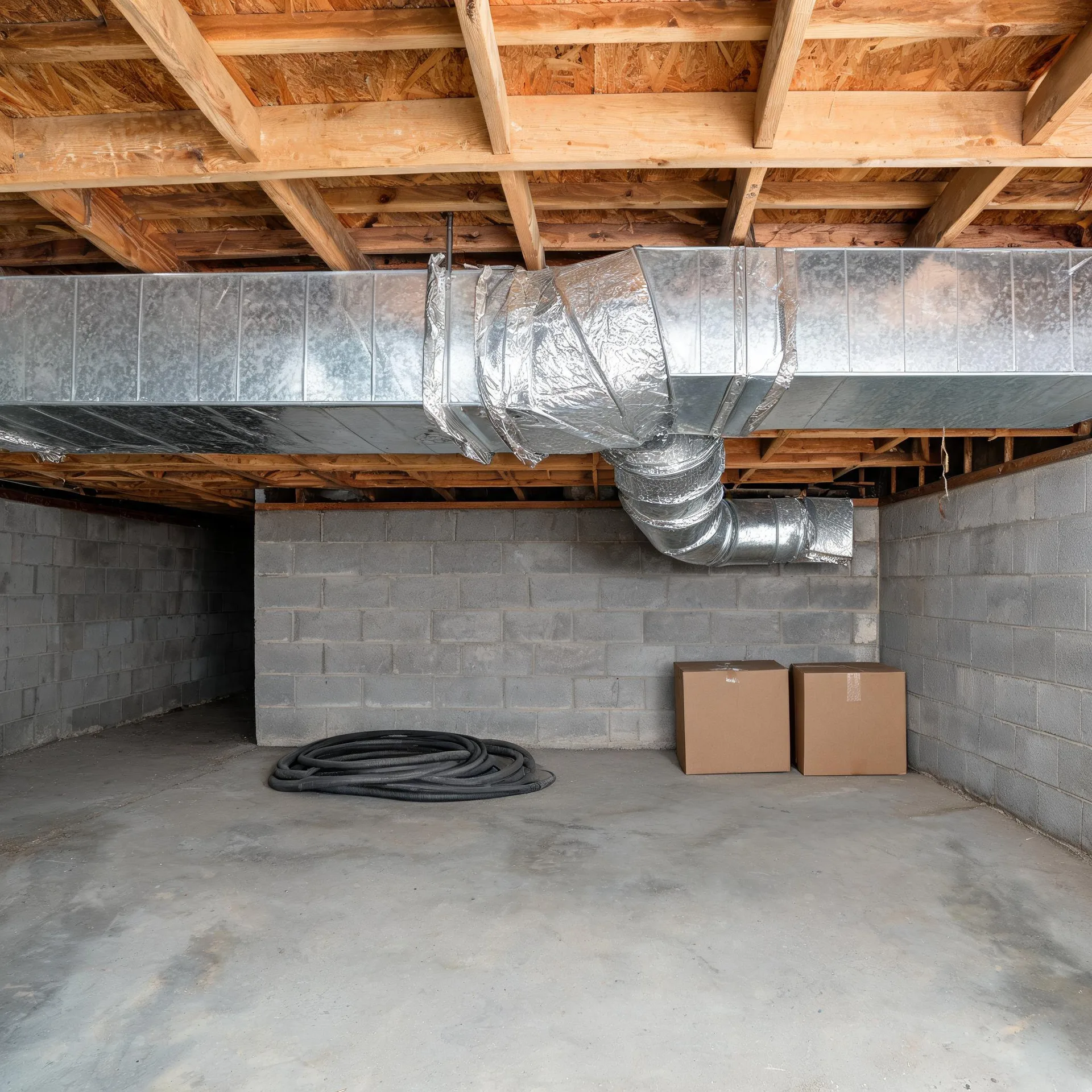
Ductwork laid down for an older generation of equipment carries its own set of dimensions, routing decisions, and static pressure assumptions. Half the homes in Kent County, Michigan were built in 1977 or earlier (2020-2024 ACS 5-year). A contractor quoting a central AC installation in this county will open return and supply runs to find out whether what is there moves enough air for a modern unit, and whether the path it takes fits the load calculation for the house as it sits today. That assessment changes the scope of the job before any equipment is priced.
What a Central AC System Includes
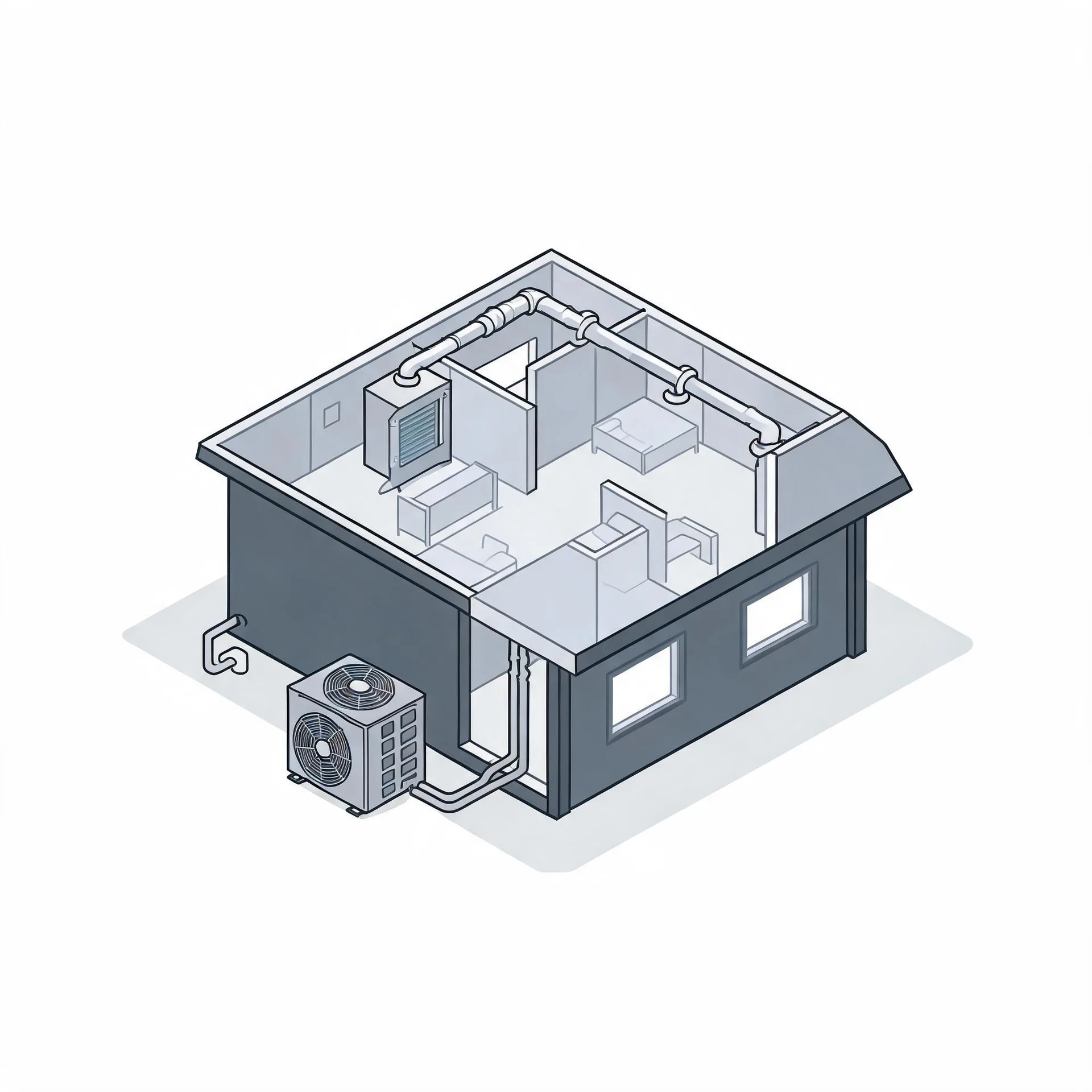
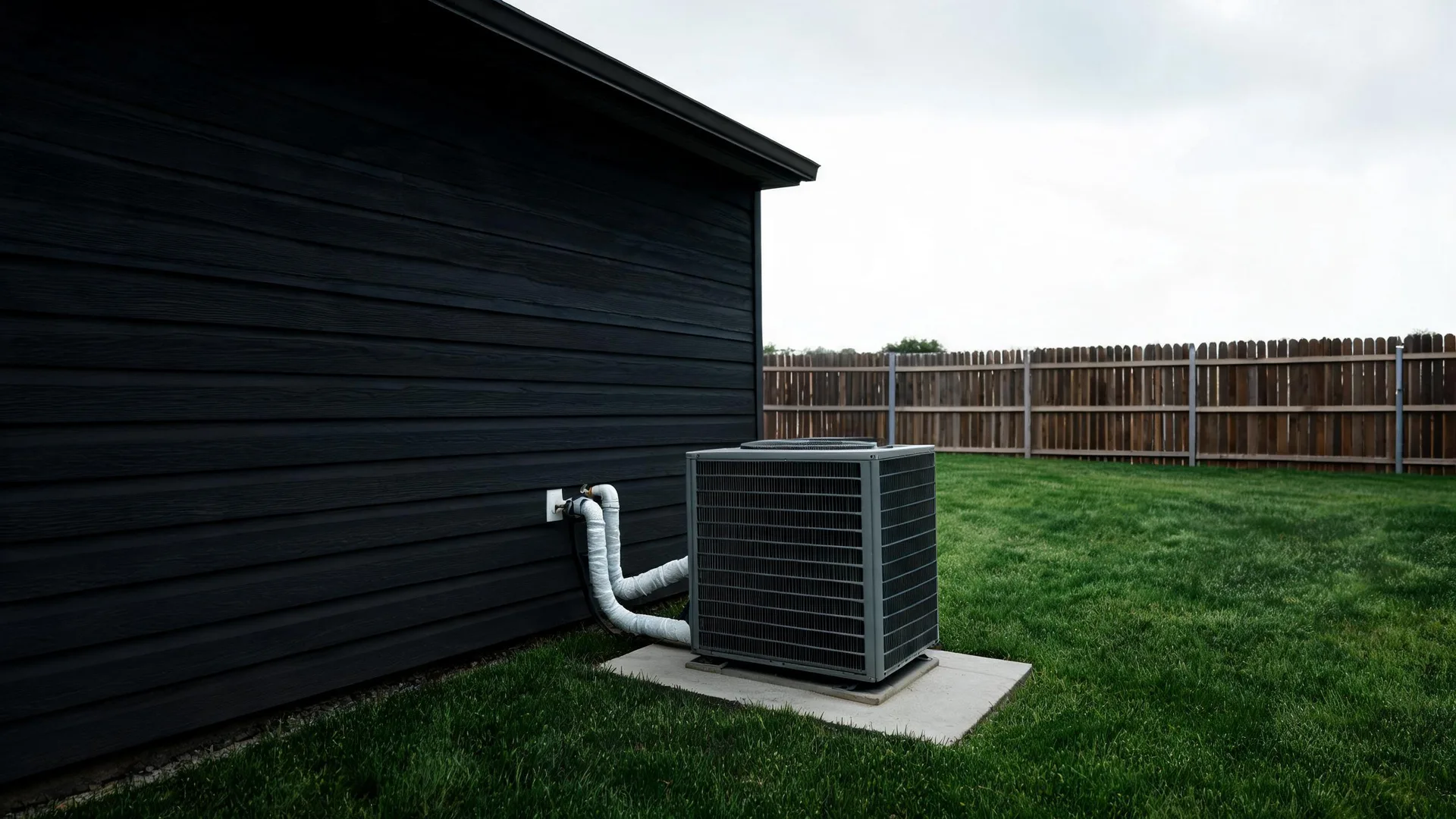
The outdoor condenser unit sits on a pad outside the house and holds the compressor and condenser coil, the two components that do the heaviest work in the system. Inside, the air handler or furnace-mounted evaporator coil lives in a utility space, basement, or closet, where it meets the air pulled from the home's living areas.
The refrigerant lines run between the outdoor and indoor units, and the thermostat mounts on an interior wall where it reads the home's temperature and tells the system when to run. A contractor also accounts for the condensate drain line, which carries moisture pulled from the air out of the living space.
The drawing shows a typical layout, and a licensed contractor determines exactly what applies to this house.
Find a contractor in Kent CountyKent County, by the numbers
90 severe weather events were recorded in Kent County, Michigan between 2015 and 2024.
NOAA National Centers for Environmental Information, Storm Events Database, bulk CSV export, events 2015-01-01 through 2024-12-31.Half the homes in Kent County, Michigan were built in 1977 or earlier (2020-2024 ACS 5-year).
U.S. Census Bureau, 2020-2024 American Community Survey 5-Year EstimatesKent County, Michigan holds 269,136 housing units (2020-2024 ACS 5-year).
U.S. Census Bureau, 2020-2024 American Community Survey 5-Year EstimatesOwners occupy 70.3% of the occupied homes in Kent County, Michigan (2020-2024 ACS 5-year).
U.S. Census Bureau, 2020-2024 American Community Survey 5-Year EstimatesCodes & Standards for Central AC Installation in Kent County, Michigan10 sourced rules & standards
What the Installation Actually Looks Like
Split-system central air conditioners rated below 45,000 Btu/h manufactured on or after January 1, 2023 must meet a federal minimum of 13.4 SEER2.
Split-system central air conditioners rated at or above 45,000 Btu/h manufactured on or after January 1, 2023 must meet a federal minimum of 13.4 SEER2.
Split-system central air conditioners manufactured between January 1, 2015 and December 31, 2022 had to meet 13 SEER, the metric that preceded SEER2.
Single-package central air conditioners manufactured on or after January 1, 2023 must meet a federal minimum of 13.4 SEER2.
Space-constrained central air conditioners manufactured on or after January 1, 2023 must meet a federal minimum of 11.7 SEER2.
Federal efficiency standards for split-system central air conditioners and heat pumps are set on each certified combination of outdoor unit and indoor coil rather than on the outdoor unit alone.
Residential and light commercial air conditioning and heat pump systems assembled in the field, including mini-splits and unitary systems, may not be installed on or after January 1, 2025 using a refrigerant with a global warming potential above 700.
A field-assembled system whose specified components were all manufactured or imported before January 1, 2025 carries no installation compliance date under the refrigerant restrictions and may still be installed.
What Kent County, Michigan Requires for This Work
Michigan issues the mechanical contractor’s licence by classification: HVAC equipment, ductwork, refrigeration, hydronic heating and cooling, and limited or unlimited heating and refrigeration service are each a separate classification a contractor has to hold.
Michigan requires a mechanical contractor’s licence: nobody may install, alter or service the regulated mechanical work unless they, or an employee, hold a licence from the department that has not been revoked or suspended.
Severe Weather Events in Kent County, Michigan
Weather stress is a direct load on HVAC equipment: the harder the climate swings, the harder a system works to keep up. Sizing and installing central AC in Kent County is a local decision, and local conditions are part of it.
90 severe weather events, 2015–2024. Source: NOAA National Centers for Environmental Information, Storm Events Database.